
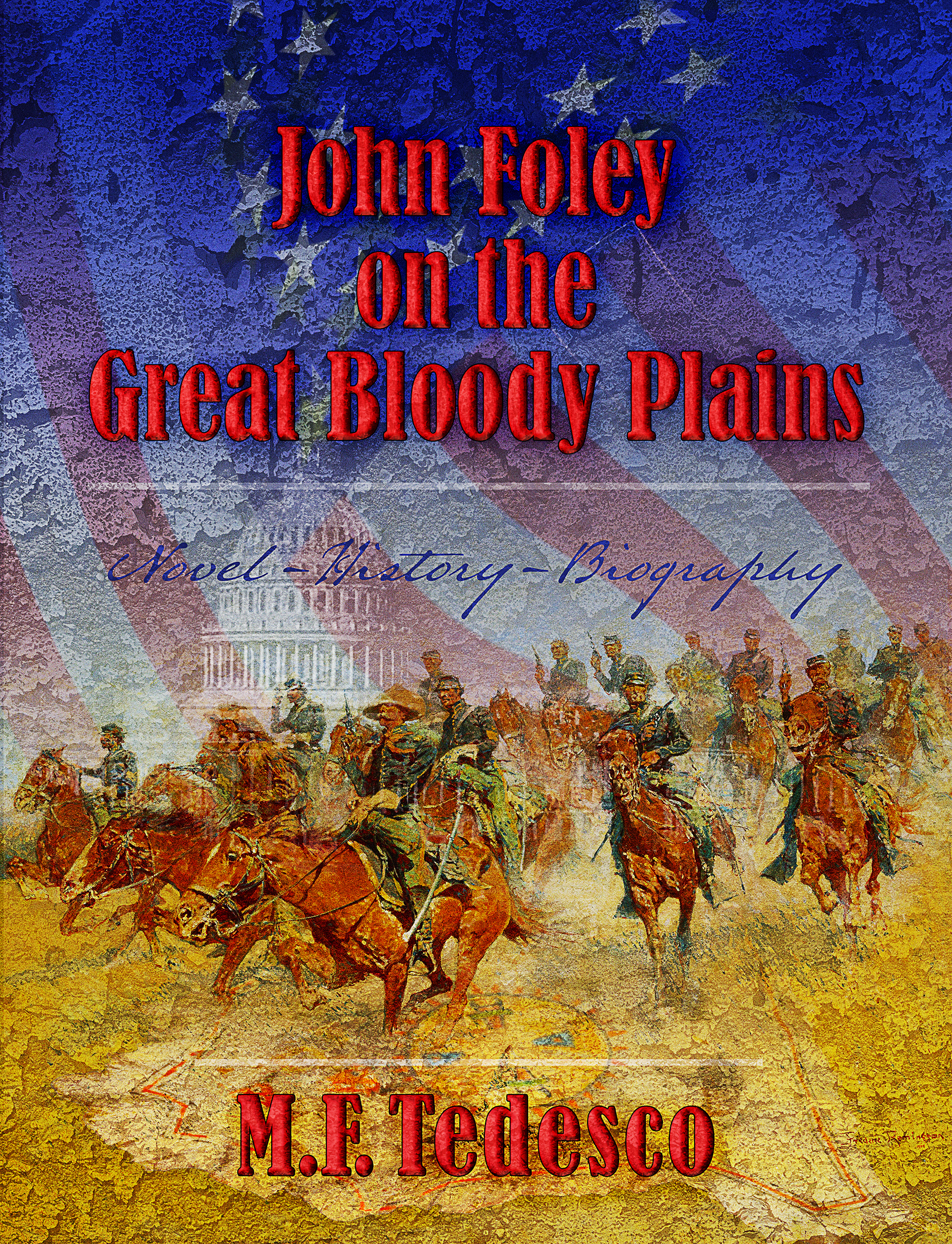
John Foley
on the
Great Bloody Plains
Two men named John Foley rode into the Valley of the Little Bighorn with George Armstrong Custer and the 7th Cavalry. Only one John Foley returned. This obscure survivor, polar opposite of the famous Custer, presents an unusual perspective, and the reconstruction of his eighty-six years results in a book where the lines between biography, history, and fiction essentially vanish. Readers familiar with only the more popular anecdotes regarding the War Between the States, Reconstruction, and the Plains Indian Wars will find themselves in Foley’s boots, confronted with the gritty, factual depictions of a distinctly American time capsule.
• • •
Little more than a boy when he arrives from Ireland, John toils for a decade on the canals, railroads, and farms of Ohio. At twenty-one, spurned by his unfaithful lover, he joins the Federal cavalry at the outset of the Civil War. Following the Confederate surrender, John finds himself without prospects. Facing trouble with the law, he flees to Chicago, enlists in K Troop of the newly formed 7th Cavalry, and is promptly stationed on the Great Plains. Led in the field by Custer, the famous Union war hero, the 7th endeavors to protect frontier settlers, overland travelers, and most importantly, the fledgling railroad’s westward expansion.
While no soldier is safe from the native warriors fighting to turn back the White invasion into the lands of their ancestors, garrison life holds dangers of its own. Foley’s perceived interest in Elizabeth Custer raises the ire of her husband. When troops are requested for Reconstruction duty in the South, John’s K Troop is among the first chosen to go, and it serves there until the Federal Government all but abandons its twelve-year shadow war against the Ku Klux Klan and its allies.
On the eve of the country’s eagerly awaited centennial celebration, and for the first time in the 7th Cavalry’s ten-year history, all twelve companies assemble in the Dakota wilderness. They march into uncharted Montana Territory, ordered to find and punish the free Sioux and Cheyenne for their refusal to accept the latest demand from the Great White Father in Washington. The disastrous campaign results in the utter disintegration of military order, the death of Custer, and nearly half the regiment. In the aftermath, Private John Foley, afflicted body and mind, faces a future dependent upon the bureaucrats who dole out his meager pension. Confronted with overwhelming odds once again, John fights on, obsessed by visions of love, devotion, and independence.
Read the first two chapters:
John Foley on the Great Bloody Plains
©M.F. Tedesco
©M.F. Tedesco
Foreword
It is only through conceit granted by the comfortable distance of time and place that we of the present are thereby enabled to pass summary judgment upon the actions of our predecessors. – A. Pensieri
Chapter 1
Cavalry-Calvary
Bullets sizzle above or snap into the ground. Scattered soil blinds him. Beneath tortured eyelids, bolts of crimson abrade. “Don’t rub! Idjit! That’ll only make it worse.” Pressed flat against the dirt, he prays for enough tears to wash out the grit. By the time John Foley recovers his sight, the firing has tapered off to a few potshots. He raises his head and looks down on the river valley.
— ∞ —
A man feels smaller than a gnat trapped under a three-ring circus tent. The immense turquoise dome surrounds everything. Hazy blue bands encircle the pinkening horizon and blend with the distant periphery, and when the vapor recedes, the great bloody plains emerge. Carved upon them like massive waves of a fossilized, prehistoric sea, jagged peaks soar and abysmal valleys plunge. In-between lie lush, boundless prairies, haunted occasionally by nomads, encroachers, and dwindling buffalo.
Many miles closer, faraway tints of pale cerulean turn deep green, yellow, and brown. The serpentine river wiggles in and out of sight reflecting the late afternoon sky and oasis-like stands of timber. Dozens of tepees border the steep banks and shallow fords. John Foley knows there are hundreds more hidden behind the screening bluffs of the deceptive landscape. He strains to see the rest of the enormous village, but huge clouds of plains’ soil and gunpowder choke the foreground.
Disembodied from the earth, hundreds of feathered horseback riders appear upon rise after rise after rise; faces, naked torsos, and sinewy arms war painted with designs of yellow, scarlet, green, white, and black. Their outraged killing hands bristle with weapons. They fire rifles and pistols into the ragged band of White soldiers. Few blue uniformed men live, fewer still half rise to aim their revolvers or carbines before being overwhelmed. Warriors leap into the sprawling cavalrymen and their dead horses. Lances, clubs, and hatchets rain down. Raging knives, whether sharp or dull, slice bloody pelts from the heads of the utterly vanquished. Some troopers, stripped of everything, lay bleaching under the pitiless sun.
The indomitable, buckskinned General will have none of it. His long golden hair and red cravat banner the killing breeze. A beacon of eternal courage, he commands the defiant apex, a mighty warrior sired by the great god of war. Contemptuous of the inevitable, he fights on, empty revolver held like a war hammer in one hand, a saber in the other. The long steel blade’s razor edge scythes sanguine arcs, defining a deadly circumference that no wise combatant dares to enter.
A discreet distance from the fighting General, a red-shirted warrior, his back to John Foley, kneels, raises his rifle, and takes careful aim. And so does one on the right, and another on the left. Just as there were three nails used to stake our Lord and Savior to the cross of His martyrdom, this triangulated field of fire, constructed by a blasphemous triumvirate, will transfigure the General. There is nothing more to be done. Nothing. It’s too late. This is the end. The bloody, inglorious, sanctifying end.
Chapter 2
1897: The Last Fight, Fight
John Foley squinted hard and looked at the inscription on the bottom of the three-foot-wide lithograph. He couldn’t read, but someone who could told him it said: Custer’s Last Fight. Anheuser Busch Brewing Association, St Louis, Mo. U.S.A. Copyright 1896.
Foley blinked and returned to his stool. He sighed, raised the beer mug, and took a thoughtful swallow before replacing it on the bar in front of him.
“Sometimes Old Iron Bottom was a royal pain in the ass,” John muttered, louder than he’d intended to.
“Who you talking about, mac?” asked the young, overweight merchant with a ruddy moon face.
“Lieutenant Colonel, George Armstrong Custer, that’s who,” snapped the wiry, fifty-eight-year-old Foley.
“What the hell makes you think you know anything about General Custer or the Last Fight? Were you there?”
“That’s right.”
“Is that so? Then how come I don’t see you dead in that picture, old man? ‘Cause that’s what you would’ve been if you’d been there.”
“Expert on the subject, are you?”
“Well, pop, I’ve studied General Custer’s last fight since I was a kid.”
“And after all that nursery school reading, you don’t even know he was a lieutenant colonel.”
“He was a brevetted brigadier general by the end of the Civil War…”
“—And died a lieutenant colonel eleven years later.”
“Makes no difference, grandpa. You’re the one who said you were up on that hill, not me.”
“Fact is, I was on a different hill most of the time.”
The merchant laughed contemptuously.
“You tellin’ me you were up on yellow tail hill with chicken shit Reno and all the other cowards?”
John Foley glowered, shook his head, and turned to swallow the last of the beer he’d nursed for an hour. He thought about Cork, Madden, Clear, Winney, Hughes, and all the others. He recalled their faces plain as day. None of these smart-ass civilians knew a goddamned thing about any of those cavalrymen.
John swiveled and hammered the bottom of the heavy glass mug into the merchant’s pug nose. Before the man recovered enough to throw a punch, Foley snatched his walking stick from the bar rail. Just as he’d done thirty-four years ago at Winchester, John gripped his cane like the bayonetted musket he’d wrenched away from that poor Virginia boy and jabbed the tip deep into the moon-faced man’s blubberous gut.
The breathless merchant on the saloon floor had a friend who lunged at John, shouting incoherently. Foley smashed the white ash cane across the man’s temple and sent him down. The fellow’s dented hat flew off his head and sailed across the room. It hadn’t settled in the sawdust before two irritated barmen hustled John Foley and his walking cane through the cacophonous barroom of laughing, grumbling, shouting men.
“Giving out lessons in the saloon, Johnny boy?”
“Ha ha haaa!”
“Bloody 7th!”
“Bloody hell!”
“Sons-a-bitches!”
“Can’t we drink in peace?”
“And stay out!”
— ∞ —
Although John regretted being thrown out and banned from Dunleavy’s, there were other saloons he could go to until enough time passed and the proprietor forgot about it. Anyway, the scuffle couldn’t have been avoided once the argument got started, not after they’d hung that fancified Last Fight lithograph up where anyone and his old palsied grandfather could see it. Now every dim-witted, half-blind fool with one cloudy eye had a damned sure opinion or theory to spout off.
Twenty years in the past and he still felt just as bad about it as he did then. John didn’t care to discuss the battle, especially with people who weren’t there. Not only that, but there were more than a few men who were there that John wouldn’t speak with about it either. Not those goddamned men. To be perfectly plain, if John saw one of them lying in the road burning up on fire and begging for help, he wouldn’t stop to piss a single yellow drop on him, not even if his bladder was about to burst. Dirty sons of bitches. For the most part, John preferred being around people who were there, but didn’t talk about it much.
Truth be told, he’d gone through too much godforsaken, bloody murdering hell in his miserable life to put up with anyone’s nose twisting nonsense, and that included a big, fat, pink-faced, know-nothing, baby blowhard, and his Wild West, dime novel stories.
The fact of the matter was: Major Reno wasn’t a chicken shit coward. Major Reno was an obnoxious, ineffectual, pompous, hard-drinking, dark-cloud-hanging-over-his-head-for-life, goddamned dismal soul, and that made all the life-and-death difference in the world there was to make. If two-hundred-and-sixty-odd dead men on two hills and a valley could talk, that’s exactly what they’d all say, every goddamned time someone asked them.
To hell with it!
The three-quarter moon lent a poetic appearance to the quiet street and its darkened shop fronts. John made his way from Dunleavy’s. A light rain started. Smelled nice. Good, clean, early summer rain. He listened to the gentle pattering on his hat brim. Reminded him of the old days, when he was still in his mid-thirties.
He sniffed and nodded, reliving the creak and clink of leather and metal. The cushioning squish of saddle blankets. The snorting, rumbling trod of a thousand horses in formation, and the murmur of the riders upon their backs; men half dozing, loaded carbines and revolvers held close and ready under their slickers. Hundreds of miles from safety or civilization. Nights just like this but nowhere near here. A lifetime ago. Wouldn’t even know how to begin retracing his steps if he had to find some of those places now. He’d ridden everywhere then, following scouts and native guides deep into territories where no White men had ever gone, and some never returned. Thousands of miles on horseback. No sorrel colored Alexandra or dark bay Pegasus under him now. Foley still missed those horses. Finished breaking in Pegasus on his own. Maybe the finest mount he ever had. Why in hell had those two German boys insisted on calling the animal Peggy? Just to aggravate him, no doubt. It was something to do when there wasn’t anything better to do, and that was most of the goddamned time. The monotony of serving out there could lull a man into complacency, leaving him inattentive for signs of danger, and then all at once, the balance between life or death teetered upon the action of a split second and a whole lot of luck.
John leaned on the cane, taking most of the weight off his leg. He saw The Five Leaf Clover ahead. The gaslighted entrance shone like a beacon on a distant seacoast. Its two lamps threw bisecting rays across the asphalt walkway, illuminating just enough to make a welcoming yellow carpet. He steered toward the doorway and went inside.
— ∞ —
When John came out of the Five Leaf Clover, the town’s streets were deserted. He was alone and possessed by more than one type of spirit. Snarling defiance surged through him and he wanted anyone within earshot to know about it.
“Damn you in hell! Genuine, goddamned, pinchbeck, sons of bitches!”
Foley heard the rumble of the old regiment mounted in columns of four. When he began singing, a bold chorus of long-gone, bawdy troopers accompanied him. John and the lusty voices in his head were loud, hard, and strong, and they handled the tune with all the delicacy of young, rabble-rousing cavalrymen shoveling horseshit in a stable-yard.
Oh,
you dirty sons o’ bitches
were spanked on your faces with switches.
Your mothers in hell, could never tell
which end of ya wore the britches.
you dirty sons o’ bitches
were spanked on your faces with switches.
Your mothers in hell, could never tell
which end of ya wore the britches.
Now,
you dirty sons o’ bitches,
mix up your hats with your britches.
When you mount to ride out, the troopers all shout:
Shit in your hats, you sons o’ bitches.
you dirty sons o’ bitches,
mix up your hats with your britches.
When you mount to ride out, the troopers all shout:
Shit in your hats, you sons o’ bitches.
— ∞ —
John awoke in the barracks of the Old Soldiers’ Home. Eyes closed, his hand searched the night table. He couldn’t find the pocket watch and swore somebody had stolen it until realizing he’d slept with his pants on. John pulled the watch out by its chain, opened the case, and read the time. He’d missed breakfast by more than two hours.
He was in a foul mood. After his head cleared John realized his poor disposition had little to do with the amount of alcohol swallowed at The Five Leaf Clover, or being written up for coming in late and disturbing the peace. It was that goddamned incident at Dunleavy’s.
He’d left Washington D.C., Dayton, Danville, Columbus, Chicago, and all the others after getting a belly full, and now it was the same thing here. All the way up in Milwaukee and still couldn’t leave that battlefield far enough behind. Time to move again. Request a transfer to another facility. The only question was: Which one?
End of excerpt